
How BC Construction Companies Can Adapt and Thrive in Today's Economy
The construction industry in British Columbia has always demanded resilience. From labour shortages and supply chain disruptions to rising material costs and shifting project timelines, the past few years have tested even the most experienced contractors. And today, the landscape is shifting again, this time shaped by economic headwinds, evolving client expectations, tightening regulatory requirements, and rapid advances in technology.
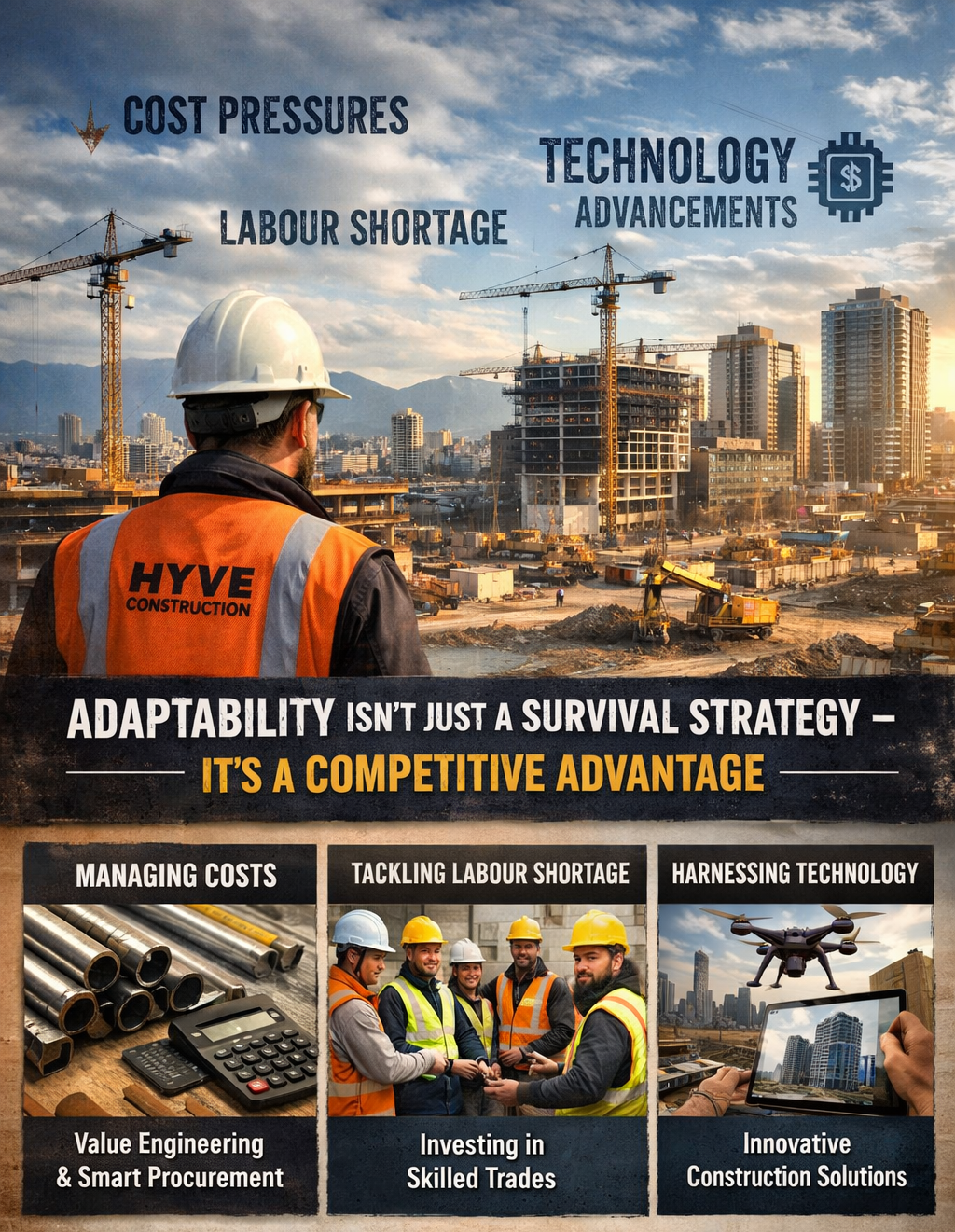
We’ve built our reputation in Langley and across the Lower Mainland by meeting these challenges head-on. We believe that adaptability isn’t just a survival strategy, it’s a competitive advantage. In this post, we’re sharing our perspective on the forces reshaping BC’s construction sector and the practical steps companies like Hyve are taking to stay ahead.
"Adaptability isn't just a survival strategy — it's a competitive advantage."
1. Navigating Cost Pressures and Economic Volatility
Construction costs in BC have climbed sharply over the past several years. Lumber, steel, concrete, and labour costs have all experienced significant volatility and there’s no sign of a full return to pre-pandemic pricing. For contractors and developers alike, this has meant thinner margins, more difficult project feasibility assessments, and, in some cases, project cancellations or deferrals.
How are savvy BC construction companies responding?
- Value engineering from day one, working with clients and designers early to find cost-effective material substitutions without compromising quality or code compliance.
- Locking in supplier pricing through preferred vendor relationships and early material procurement where project timelines allow.
- More granular and realistic contingency planning built directly into project bids and contracts.
- Diversifying project types to balance higher-risk commercial or multi-family work with steadier institutional or renovation contracts.
Hyve Tip
We’ve doubled down on transparent, open-book estimating with our clients. When everyone understands where costs are coming from, there are fewer surprises, and better trust throughout the project lifecycle.
2. Addressing the Labour Shortage Head-On
British Columbia faces a persistent skilled trades shortage that is only expected to intensify over the next decade as a large portion of the existing workforce nears retirement. For construction companies in BC this shortage shows up daily in extended timelines to find qualified sub-trades, wage pressure, and the need to carefully manage workforce capacity across projects.
The companies that will thrive are those investing in their people now:
- Recruiting actively from trades schools and apprenticeship programs to build pipelines, not just poaching employees from competitors.
- Offering competitive compensation packages that include benefits, training opportunities, and genuine career progression.
- Embracing workforce diversity by actively recruiting from underrepresented groups including women. Indigenous communities and newcomers to Canada.
- Using technology to better optimize crew scheduling and reduce wasted labour time on site.
Hyve Tip
Partner with College and University trades programs and local apprenticeship bodies. Build those relationships before you need workers and not when you’re already short-staffed will make the difference.
3. Embracing Technology Without Losing the Human Touch
The digital transformation of construction has accelerated rapidly. From Building Information Modelling (BIM) and drone site surveys to project management platforms and AI-assisted scheduling, technology is reshaping how projects are planned, built, and delivered. For smaller and mid-size contractors in BC, the question isn’t whether to adopt new tools, it’s which ones will deliver real value without overwhelming your team.
Technologies we’re seeing drive genuine improvements on BC job sites:
- Cloud-based project management platforms (like Procore) that keep stakeholders, working from the same information (single source of truth).
- 3D, 4D Modeling and BIM integration for complex commercial and institutional projects, reducing costly design conflicts before a shovel hits the ground. Solving projects ‘in the model’ before costly fixes and clashes in the shop and field.
- Digital document management streamlining RFIs, submittals, and inspection records are now critical for BC’s increasingly rigorous regulatory environment.
- Prefabrication and modular construction approaches that move work off-site, reducing weather dependency and improving schedule predictability.
Hyve Tip
Technology adoption works best when it solves a real problem your team is experiencing. Start with one system, get your people confident in using it, and build from there. Adoption is everything.

4. Meeting BC's Evolving Regulatory and Sustainability Requirements
British Columbia continues to lead Canada in progressive building codes and sustainability standards. The BC Energy Step Code, updates to the BC Building Code, and increasing municipal requirements for green building practices are raising the bar for what’s required of new construction and for the contractors who deliver it.
For construction companies, this means:
- Staying ahead of code changes through ongoing training and early engagement with building permit offices.
- Building internal expertise in energy-efficient construction methods, including high-performance envelopes, heat pump systems, and low-carbon concrete alternatives.
- Positioning sustainability capabilities such as Mass Timber and hybrid Steel/Mass Timber as a competitive differentiator and not just a compliance checkbox for institutional and municipal clients.
- Engaging early with project designers to ensure sustainability goals are integrated into construction methods, not bolted on at the end.
Hyve Tip
The Township of Langley, City of Langley and many other municipalities have been active in updating development and building standards. Establishing local relationships with municipal staff will help you navigate the permitting process efficiently which can be a real advantage for clients on time-sensitive projects.
5. Doubling Down on Client Relationships in Uncertain Times
When budgets tighten and projects get more complex, clients need contractors they can trust completely. Uncertainty in the economy actually amplifies the value of strong, transparent, long-term relationships because no one wants to take a chance on an unknown quantity when the stakes are so high.
What relationship-first contracting looks like in practice:
- Proactive communication. Flagging issues early and coming with solutions, not just problems.
- Genuine transparency on costs, timelines, and risks rather than optimistic projections that erode trust later.
- Post-project follow-through and warranty support that demonstrates that your commitment extends beyond the final invoice.
- Listening deeply to each client’s actual goals and not just project specs annd aligning your approach accordingly.
"Our best marketing has always been the projects we've already built and the clients who tell others about the experience."
Looking Ahead:
Despite the headwinds, we remain genuinely optimistic about the future of construction in BC and in Canada. Continued population growth, significant infrastructure investment, a resilient housing demand, and ambitious climate commitments all point to sustained construction activity for years to come.
The companies that will capture that opportunity aren’t necessarily the biggest, they’re the ones that are most adaptive, most trustworthy, and most invested in the quality of their people and their work.
At Hyve Construction Corp, that’s exactly the business we’re building.