For developers and general contractors in British Columbia, structural steel can be one of the most unpredictable components of a project. Budgets shift, schedules slip, RFIs multiply, and what should be a controlled, engineered system often turns into a source of risk, frustration and litigation.
The reality is the issue isn’t the steel, it’s how and when the steel team is brought into the project. When you compare BC to major U.S. markets like New York City, Chicago, and Las Vegas, the difference is not talent or capability, it’s in the delivery model and integration of engineering and detailing teams.
The Core Problem: The Steel Team Is Engaged Too Late
In many BC projects, structural steel is treated as a downstream trade. Design progresses to barley a level of completion, but never fully complete, steel is then tendered as a fixed-price package and fabricators are expected to build from a design they did not influence.
Fabricators are required to onboard specialist steel detailers to analyze design drawings, request clarifications, and begin the RFI process seeking clarity on missing or ambiguous design details and or to comment on constructability and fabrication efficiency in the design.
By the time a Fabricator and detailer become involved, key decisions have already been made, often without input from the people who detail, fabricate and erect the steel. The result is inefficient structural systems, higher tonnage than necessary, increased RFIs and coordination issues leading to Change orders, and cost growth during construction.
What You’re Really Paying For: Inefficiency and Risk
When a steel team is brought in late, the system naturally becomes defensive. Fabricators include contingency in pricing (incomplete design = increased risk they must factor in). Contractors push risk downstream and Consultants protect design intent rather than optimizing for buildability. All of which leads to higher initial bids, more change orders and less predictability. In other words, the project owner ends up paying a premium for uncertainty in design.
What Happens Differently in Major U.S. Markets
In cities like New York, Chicago, and Las Vegas, steel is not treated as a commodity, it’s treated as a system level partner.
The Steel Team is Engaged Early (Design-Assist is Standard)
Expert Steel Detailers are typically brought in at 30–60% design, where they can influence structural systems, optimize connection design and improve erection sequencing which results in lower steel tonnage, fewer design conflicts, better fabrication and more efficient construction.
Integration Between Design and Construction
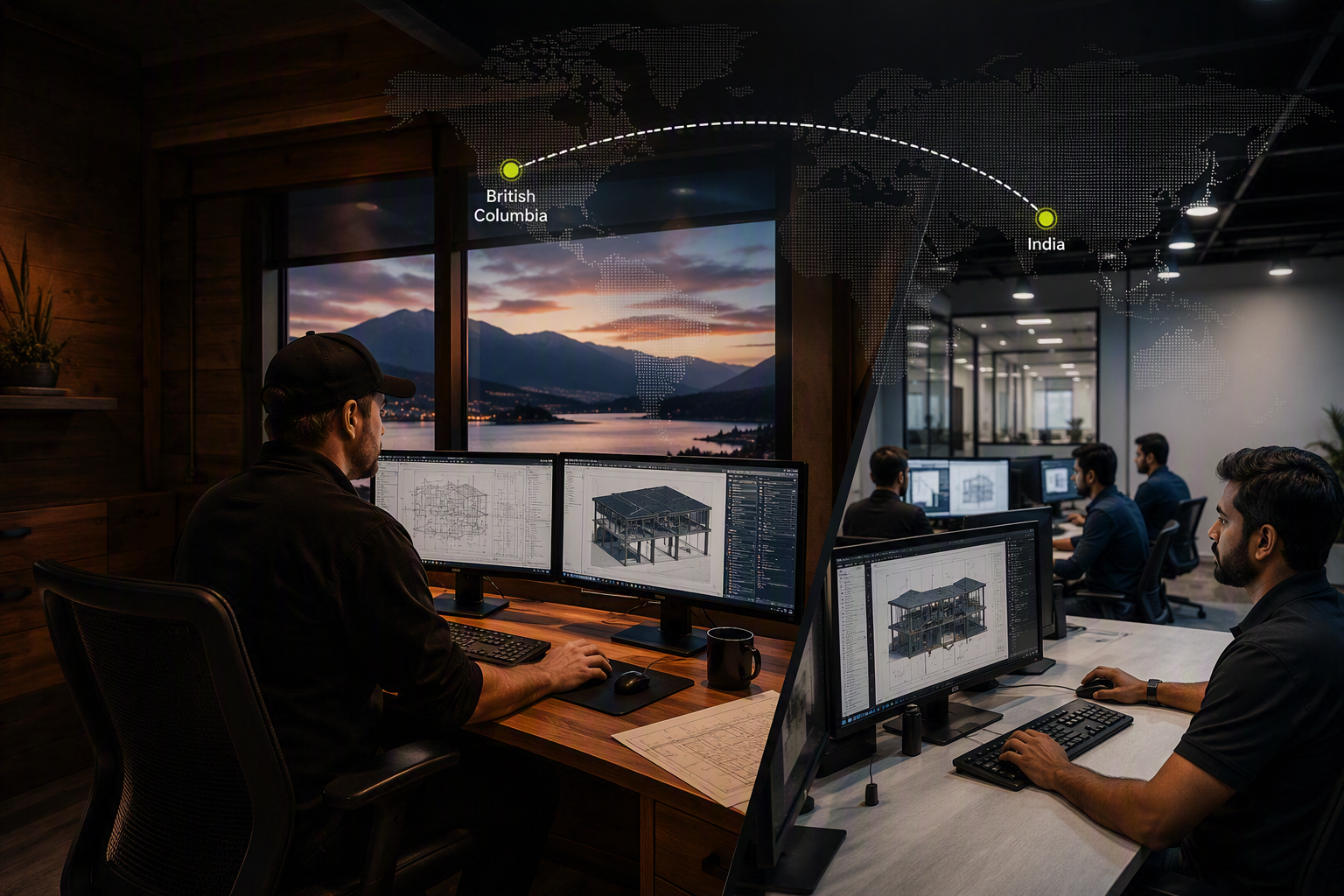
Top performing projects in these markets bring together, engineers, detailers early, then fabricators and erectors. Early engineer, detailer collaboration leads to better coordination, fewer field issues, reduced rework and having a Fabrication Ready Model at Bidding Stage.
Steel Contractors Can Help Solve Schedule Challenges
In these markets, steel contractors compete by offering erection strategies, supporting fast-track schedules and providing certainty, not just pricing. Schedule reliability becomes a key differentiator. Ie the most efficient fabricator wins, not the fabricator who exploits the change order process.
A More Collaborative Contracting Models that works
Design-build and construction management at risk (CMAR) is becoming more common. These models, align incentives early, and encourage innovation, and reduce adversarial relationships.
What This Means for Developers and GCs in BC
If your goal is to improve margins, reduce risk, and deliver more predictable projects, the opportunity is clear: Bring the steel team into the conversation earlier and treat them as a partner, not a bid item.
Practical Changes That Make a Big Difference
Engage Steel at the Right Time. Even moving steel involvement forward by a few months can reduce tonnage, improve constructability and can eliminate coordination issues
Invite Fabricators Into the Design Process
Design-assist involvement allows fabricators to work with integrated design detailers to identify inefficiencies early, suggest buildable solutions and helps optimize the system before it’s locked in.
Prioritize Schedule Certainty Alongside Cost
The lowest bid is rarely the lowest cost. Projects that reduce delays, minimize RFIs, and prevent redesign often deliver significantly better overall value.
Build Relationships With Proven Steel Partners
The most successful projects are rarely one-off transactions. They’re built on repeat partnerships, trust and proven performance.
The Opportunity
There is a clear gap in the BC market. Most projects still follow a traditional model where steel is engaged late, coordination happens after design is largely complete and value is lost in translation between disciplines.
The projects that consistently outperform are the ones where Engineers and Detailers work together. Steel is engaged early, teams are integrated, and decisions are made collaboratively
Final Thought
For developers and GCs, this isn’t about changing everything at once. It’s about one simple workflow change. Move steel upstream in your process. Have detailers engaged early working alongside engineers to create a complete Virtual Steel Fabrication Ready Model (LOD400)
That single change can reduce cost, improve schedule certainty, lower risk and significantly improve project outcomes.
The companies that adopt this approach will consistently outperform those that don’t.
About the Author
Ewen Dobbie has more than 30 years of experience in the steel industry and with Dowco, where he led the company’s Technology and Software Development Division as well as its global 3D Modeling, Detailing, BIM, and Pre-Construction Services operations. As Dowco was the first North American user and reseller of Tekla Structures, Mr. Dobbie played a foundational role in advancing the adoption of 3D modeling and the emergence of BIM across the North American market.
He leverages this broad, hands-on experience to position DeSimone/Dowco as a leading global provider of integrated, end-to-end solutions spanning structural design, detailing, steel procurement, fabrication, erection, and construction management.
A serial entrepreneur, Mr. Dobbie acquired and transformed a traditional, low-tech general contracting business into Hyve Construction Corp., a modern, technology-enabled, and highly collaborative builder capable of advancing complex structural steel, mass timber, and modular construction projects.
About Us
DeSimone Consulting Canada Ltd (2023 acquired Dowco Consultants Ltd ) specializes in advancing structural steel project delivery solutions for projects worldwide through early-stage collaboration, engineering detailing integration, and fabrication expertise. Our integrated team of engineers and detailers approach focuses on optimizing projects from the outset to deliver measurable value to our clients.
Hyve Construction Corp. is a full-service construction and development management company specializing in commercial, institutional, and residential projects across Western Canada. With a focus on collaboration, quality, and community, Hyve provides end-to-end services from feasibility and design through construction and delivery.